Most organizations approve training programs before asking the most important question of all — what behaviors does our business strategy actually require? Two foundational frameworks change how you think about every L&D investment decision.
Before you allocate a single baht to leadership development, there is a more important question than “what programs should we run?” — and most organizations never stop to ask it.
Walk into most L&D planning meetings and you will find the conversation starting in the wrong place. Teams browse training catalogs. They ask what was popular last year. They approve programs based on what colleagues recommend, what fits the budget cycle, or what a vendor happened to present at the right moment.
The question that is almost never asked first: What specific behaviors does our business strategy require our leaders to demonstrate — and are we building our development investment around those?
Development that is not anchored to desired behaviors is not development. It is activity. Expensive, well-intentioned activity that produces satisfaction scores, completion certificates, and very little lasting change in how leaders actually show up at work.
“The most dangerous L&D decision is not investing too little. It’s investing confidently in the wrong things.”
Start with strategy — not programs
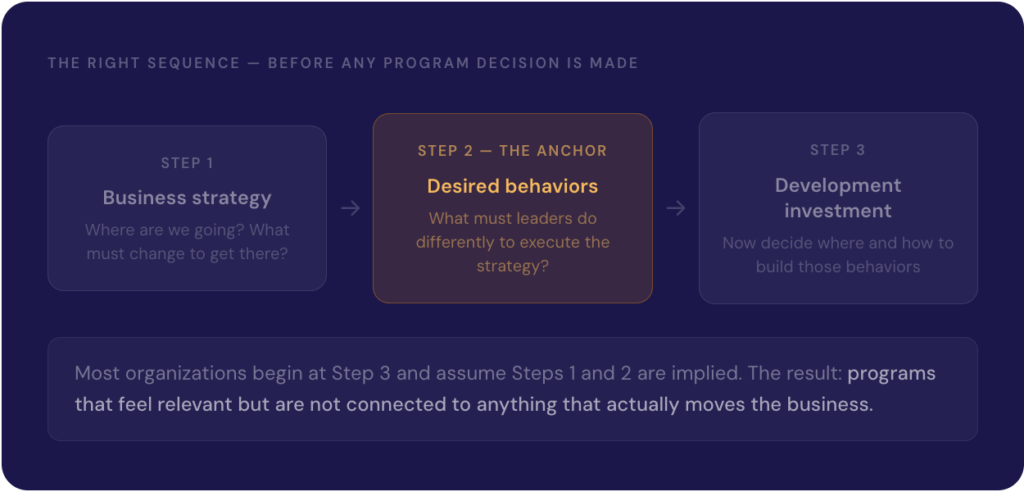
The sequence matters more than most organizations realize. The organizations that genuinely build competitive advantage through their people share a common discipline: they start with a strategic question — where are we trying to go, and what must our leaders do differently to get us there?
Desired behaviors become the anchor for every subsequent decision: what to develop, how to develop it, how to measure whether it worked, and how to justify the investment to the business. When this sequence is reversed — when programs are chosen first and behaviors are assumed — the L&D function gradually becomes a cost center rather than a strategic driver.
Framework 1: The 70-20-10 model — your budget reveals what you believe
First documented by researchers at the Center for Creative Leadership, the 70-20-10 model describes how leaders actually develop — not how organizations tend to assume they do.
The pattern is consistent across industries and cultures: approximately 70% of meaningful leadership development comes from challenging on-the-job experiences. Another 20% comes from learning from others — through feedback, observation, coaching, and honest conversation. Only 10% comes from formal training: courses, workshops, and structured programs.
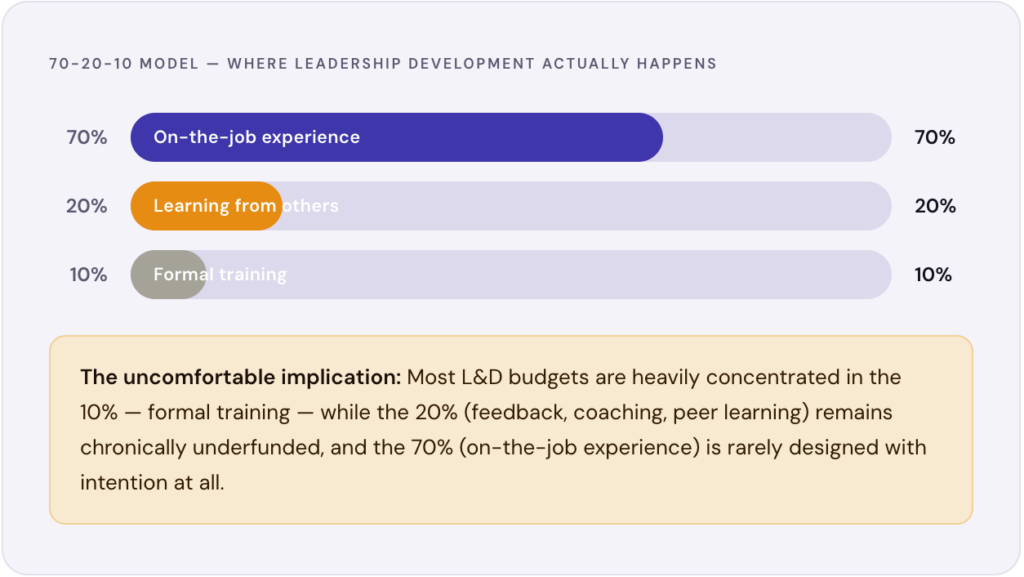
This is not an argument against formal training. Workshops and structured programs have genuine value — particularly for introducing frameworks and creating shared language. But they cannot produce lasting behavioral change on their own. The 10% needs the 20% to take root and the 70% to embed.
The strategic implication is significant: if you want to build specific behaviors tied to your strategy, the highest-leverage investment is often not in more programs — it is in the feedback and learning environments that surround your leaders between programs.
Framework 2: Phillips ROI — translate development into language the business respects
Jack Phillips extended Kirkpatrick’s model by adding a fifth level: financial Return on Investment. But the most valuable part of the Phillips methodology is not the ROI calculation itself — it is the discipline it forces before any investment decision is made.
Phillips asks organizations to define in advance: what behavioral and business outcomes do we expect from this initiative, and how will we isolate the program’s contribution from other factors? This pre-investment planning transforms L&D from a spend category into an accountable business function with a clear return hypothesis.
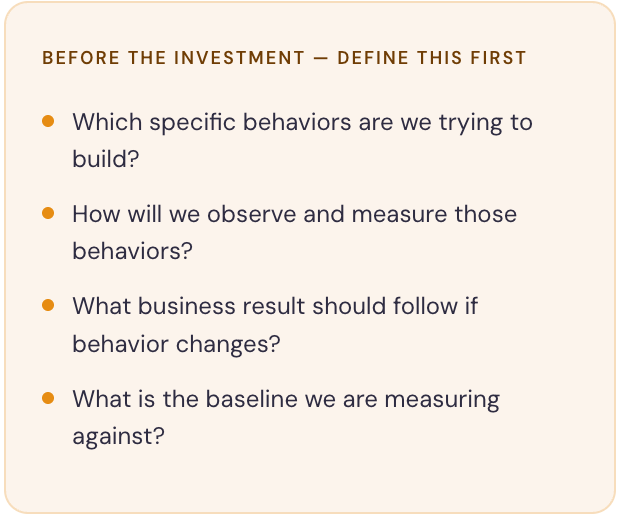
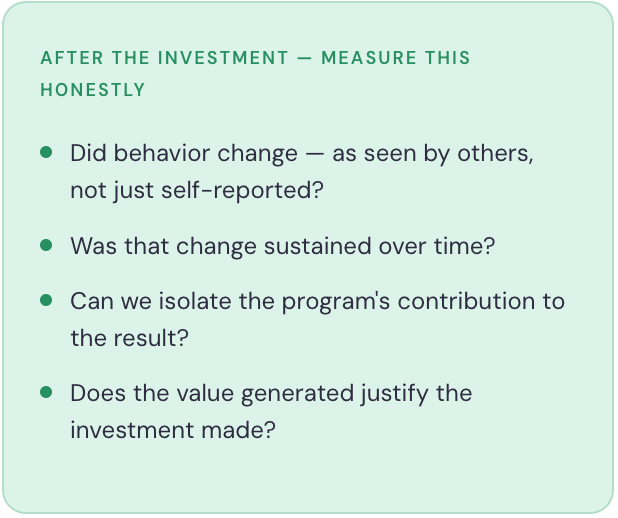
One implication of the Phillips approach is particularly important: the moment you commit to measuring behavioral change before and after a program, the question of how you will observe that change becomes unavoidable. Self-assessment alone is insufficient — research consistently shows that self-perception of behavioral change is an unreliable proxy. External data, gathered from the people who experience the leader’s behavior directly, is what makes the measurement real.
Kirkpatrick Levels 3 and 4 as strategic tools — not retrospective checkboxes
Most organizations treat the Kirkpatrick model as something you apply after a program ends, to assess whether it was worth running. Used strategically, however, Levels 3 and 4 belong at the beginning of every L&D decision — before a single program is designed or a single budget line is approved.
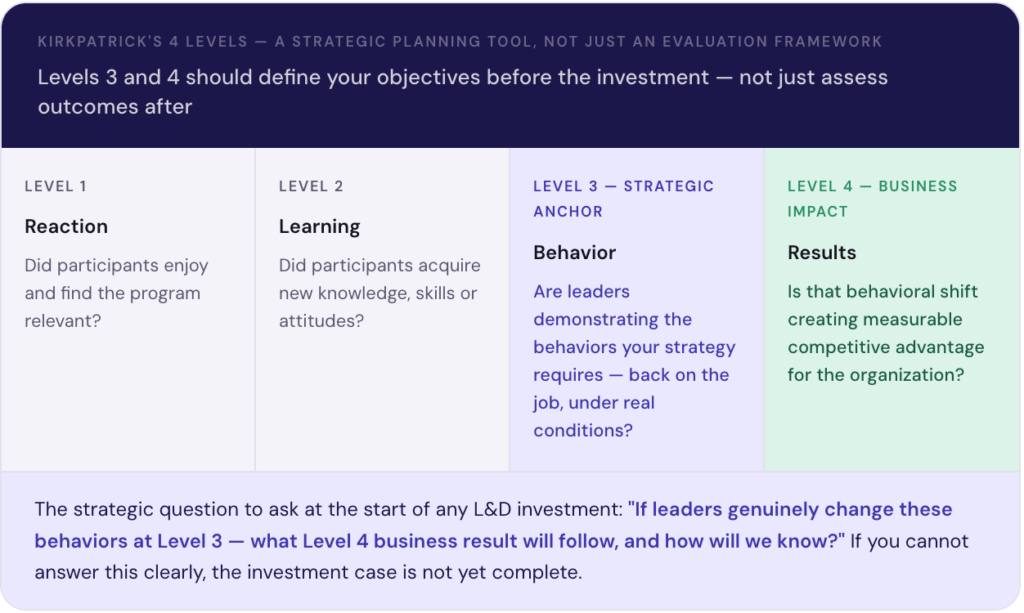
When Level 3 behaviors are defined upfront — anchored in what the business strategy actually needs — the entire L&D function gains a clarity that program-first thinking never produces. Development stops being measured in inputs (courses delivered, hours completed) and starts being measured in outputs: leaders who behave differently, and businesses that perform better as a result.
The question every framework eventually arrives at
Across the 70-20-10 model, Phillips ROI, and Kirkpatrick Levels 3 and 4, a shared gap eventually surfaces: if desired behaviors are the anchor for L&D investment, and behavioral change is the proof of return on that investment — who is watching whether those behaviors actually changed?
The 20% in the 70-20-10 model — learning from others — points toward the answer. But it requires a mechanism: something that gathers structured, honest input from the peers, team members, and managers who actually experience a leader’s behavior every day. Not a self-report. Not an end-of-program survey. An external view, gathered from the people closest to the work.
In the next article in this series, we explore how organizations can use that mechanism to make more intentional decisions about who to develop, what to focus on, and how to design development programs that are built around the behaviors that matter most — before the first session is ever run.
Curious how other organizations are connecting L&D investment to business outcomes?
We’d be glad to share what we’re seeing — no pitch, just a conversation.