Are You Spending Your L&D BudgetWhere Development Actually Happens?

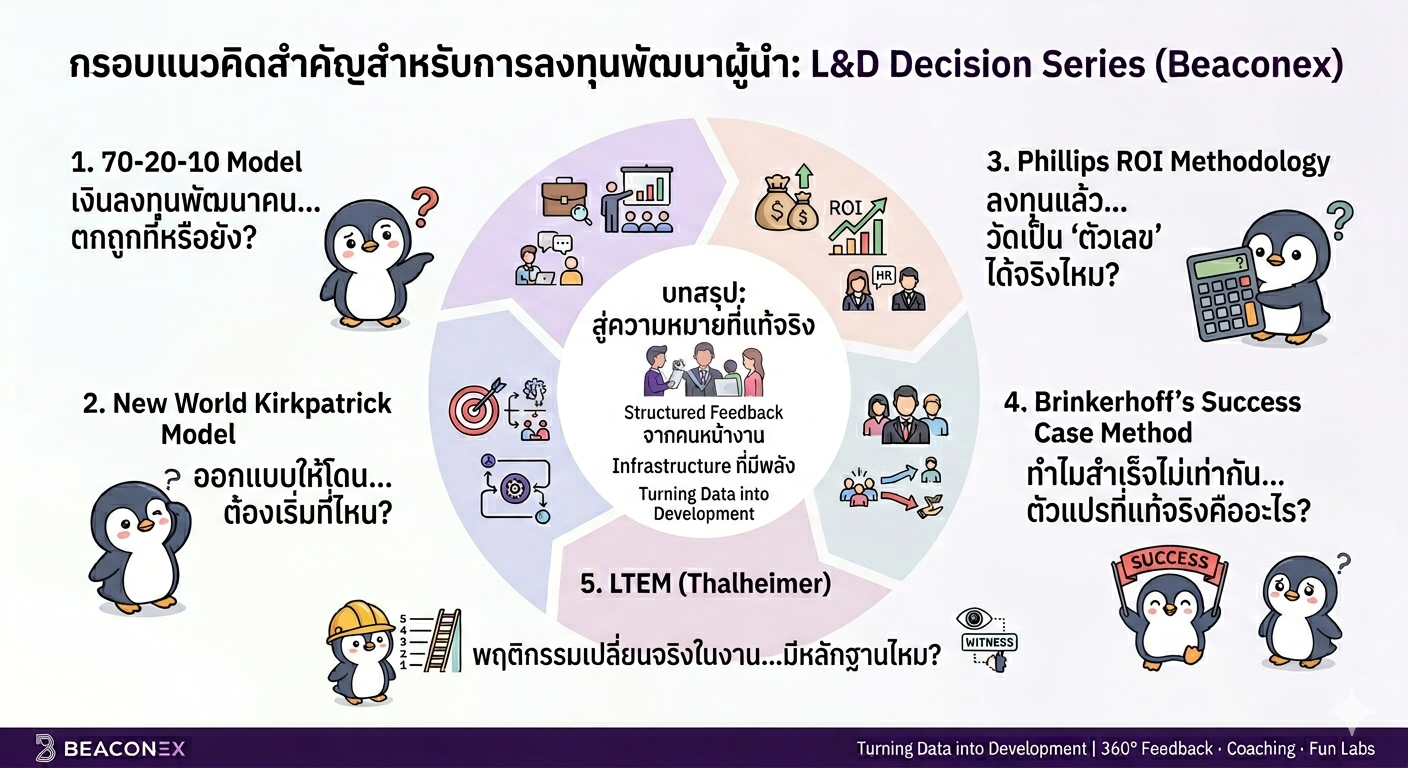
Most organizations approve training programs before asking the most important question of all — what behaviors does our business strategy actually require? Two foundational frameworks change how you think about every L&D investment decision.

Before you allocate a single baht to leadership development, there is a more important question than “what programs should we run?” — and most organizations never stop to ask it.

Walk into most L&D planning meetings and you will find the conversation starting in the wrong place. Teams browse training catalogs. They ask what was popular last year. They approve programs based on what colleagues recommend, what fits the budget cycle, or what a vendor happened to present at the right moment.

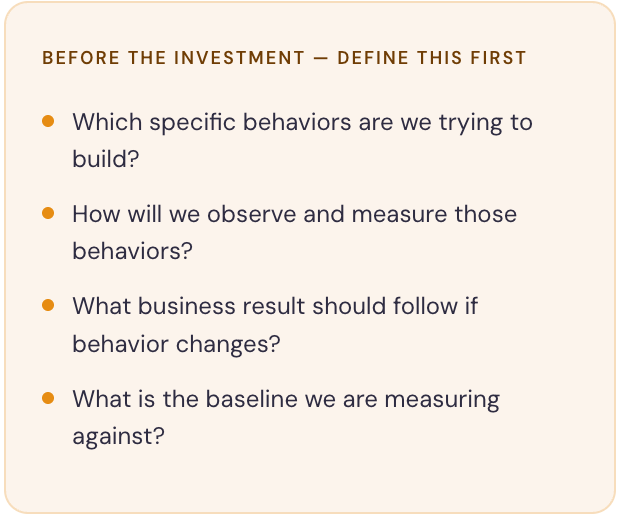
The question that is almost never asked first: What specific behaviors does our business strategy require our leaders to demonstrate — and are we building our development investment around those?

Development that is not anchored to desired behaviors is not development. It is activity. Expensive, well-intentioned activity that produces satisfaction scores, completion certificates, and very little lasting change in how leaders actually show up at work.

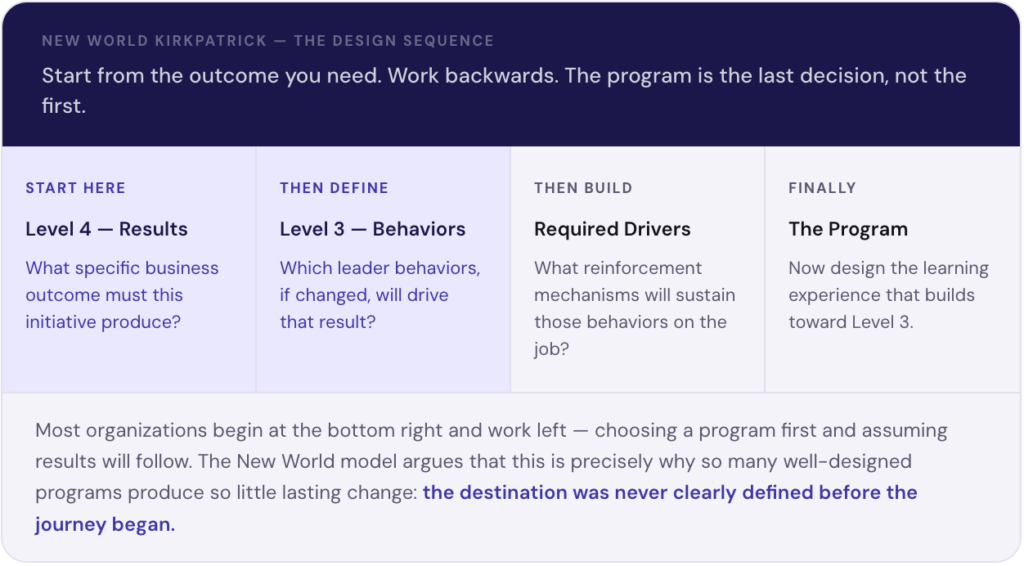
Start with strategy — not programs

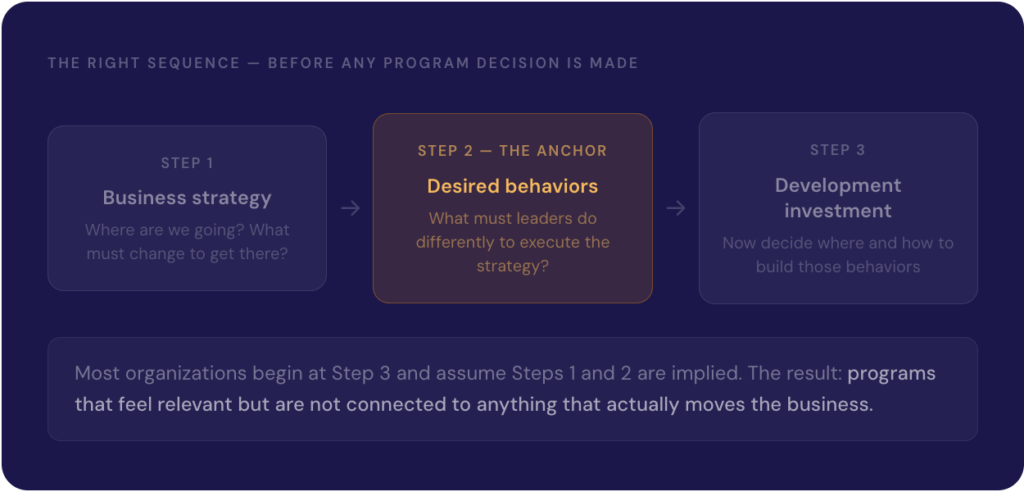
The sequence matters more than most organizations realize. The organizations that genuinely build competitive advantage through their people share a common discipline: they start with a strategic question — where are we trying to go, and what must our leaders do differently to get us there?

Desired behaviors become the anchor for every subsequent decision: what to develop, how to develop it, how to measure whether it worked, and how to justify the investment to the business. When this sequence is reversed — when programs are chosen first and behaviors are assumed — the L&D function gradually becomes a cost center rather than a strategic driver.

Framework 1: The 70-20-10 model — your budget reveals what you believe

First documented by researchers at the Center for Creative Leadership, the 70-20-10 model describes how leaders actually develop — not how organizations tend to assume they do.

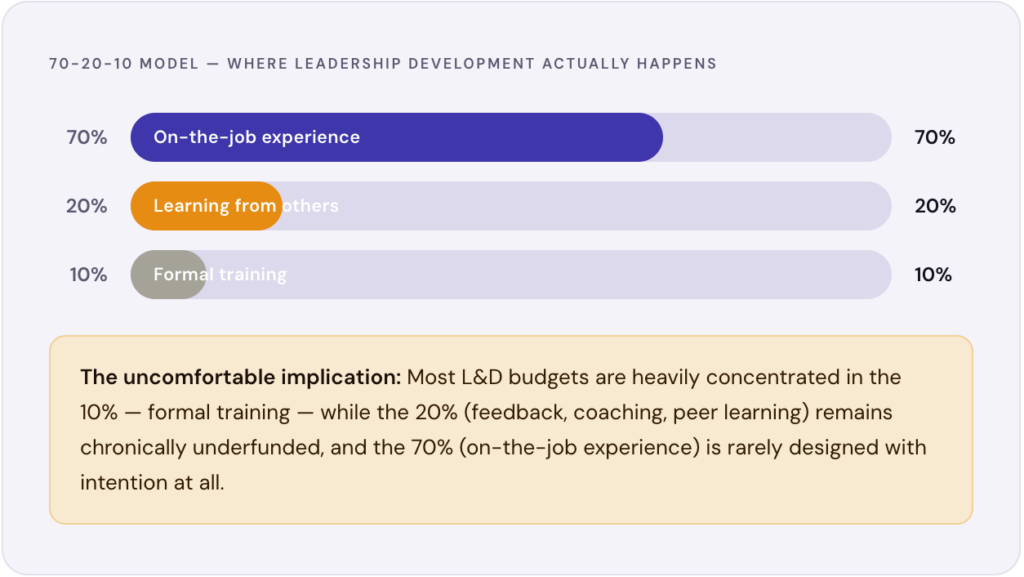
The pattern is consistent across industries and cultures: approximately 70% of meaningful leadership development comes from challenging on-the-job experiences. Another 20% comes from learning from others — through feedback, observation, coaching, and honest conversation. Only 10% comes from formal training: courses, workshops, and structured programs.

This is not an argument against formal training. Workshops and structured programs have genuine value — particularly for introducing frameworks and creating shared language. But they cannot produce lasting behavioral change on their own. The 10% needs the 20% to take root and the 70% to embed.

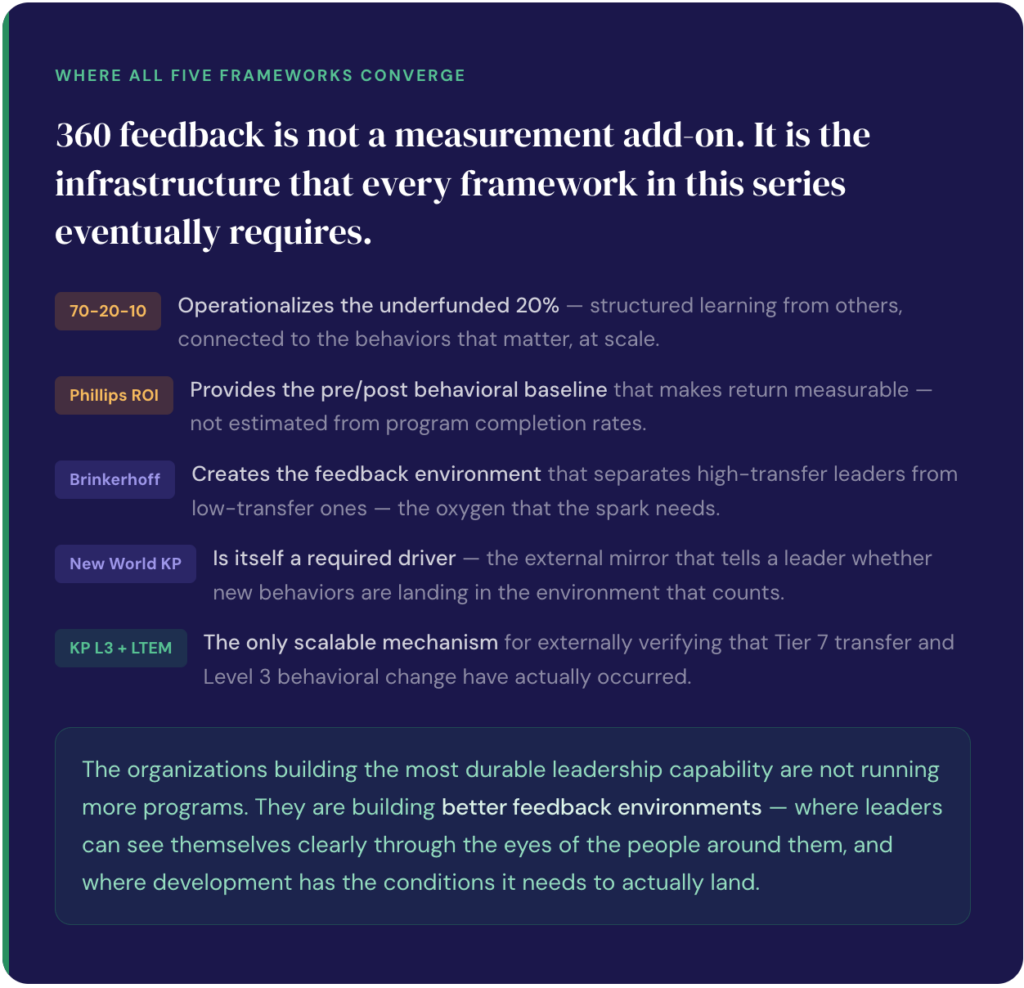
The strategic implication is significant: if you want to build specific behaviors tied to your strategy, the highest-leverage investment is often not in more programs — it is in the feedback and learning environments that surround your leaders between programs.

Framework 2: Phillips ROI — translate development into language the business respects

Jack Phillips extended Kirkpatrick’s model by adding a fifth level: financial Return on Investment. But the most valuable part of the Phillips methodology is not the ROI calculation itself — it is the discipline it forces before any investment decision is made.

Phillips asks organizations to define in advance: what behavioral and business outcomes do we expect from this initiative, and how will we isolate the program’s contribution from other factors? This pre-investment planning transforms L&D from a spend category into an accountable business function with a clear return hypothesis.

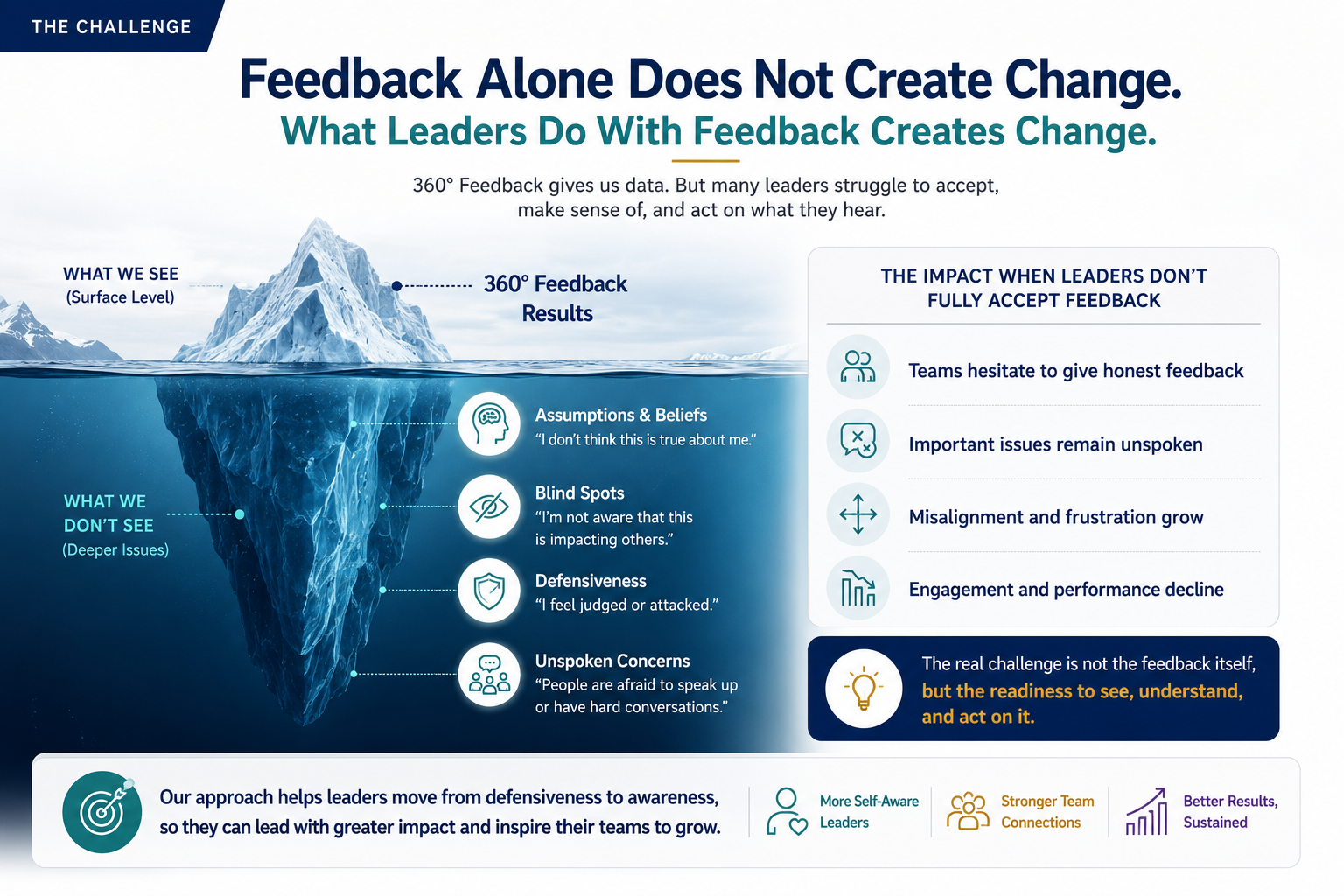
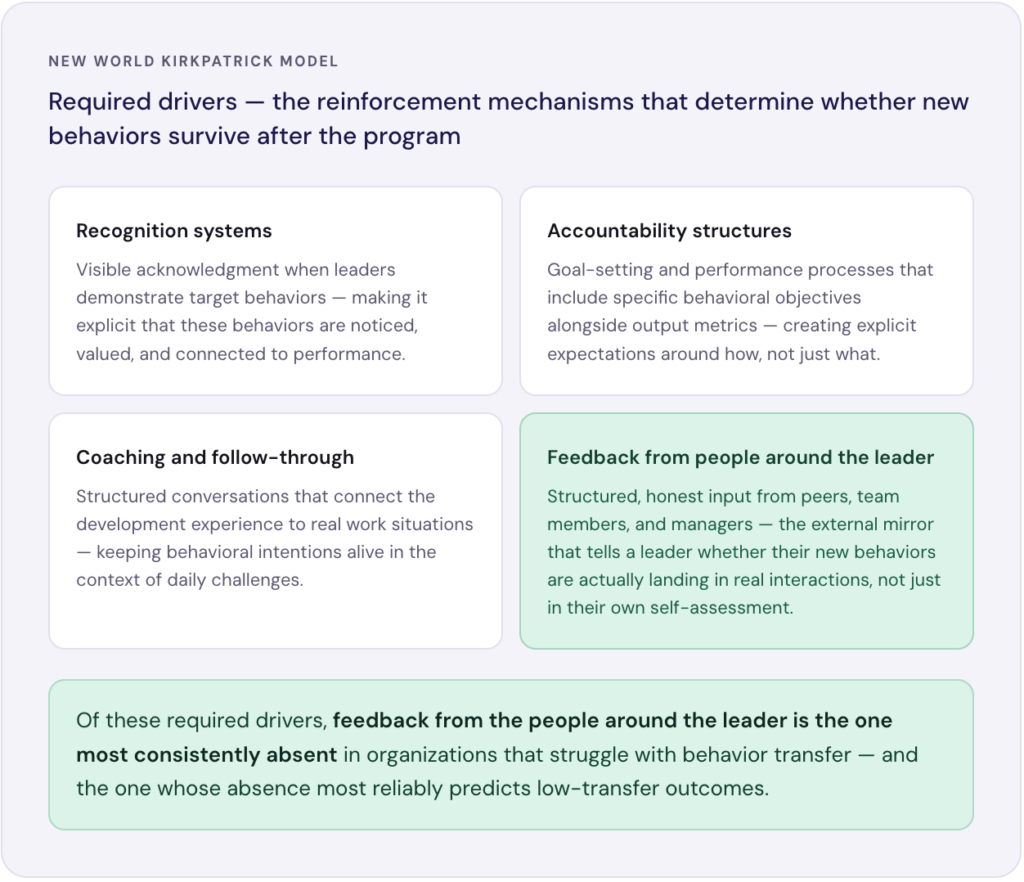
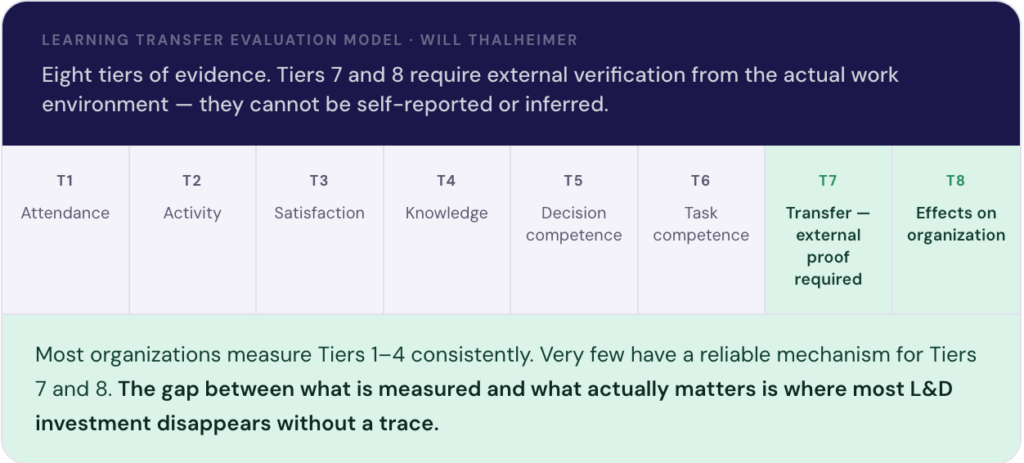
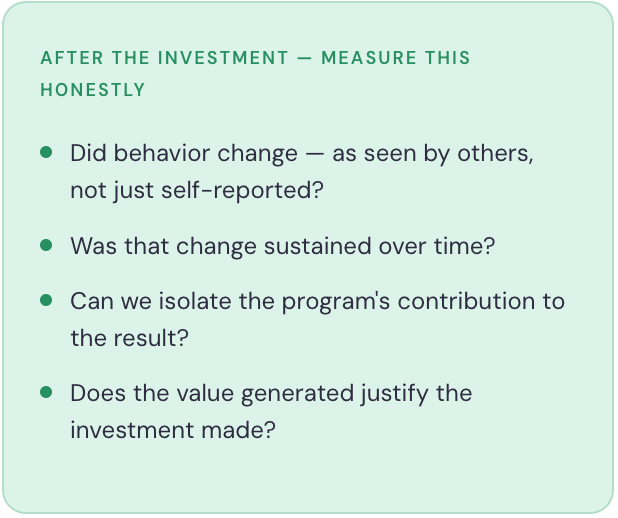
One implication of the Phillips approach is particularly important: the moment you commit to measuring behavioral change before and after a program, the question of how you will observe that change becomes unavoidable. Self-assessment alone is insufficient — research consistently shows that self-perception of behavioral change is an unreliable proxy. External data, gathered from the people who experience the leader’s behavior directly, is what makes the measurement real.

Kirkpatrick Levels 3 and 4 as strategic tools — not retrospective checkboxes

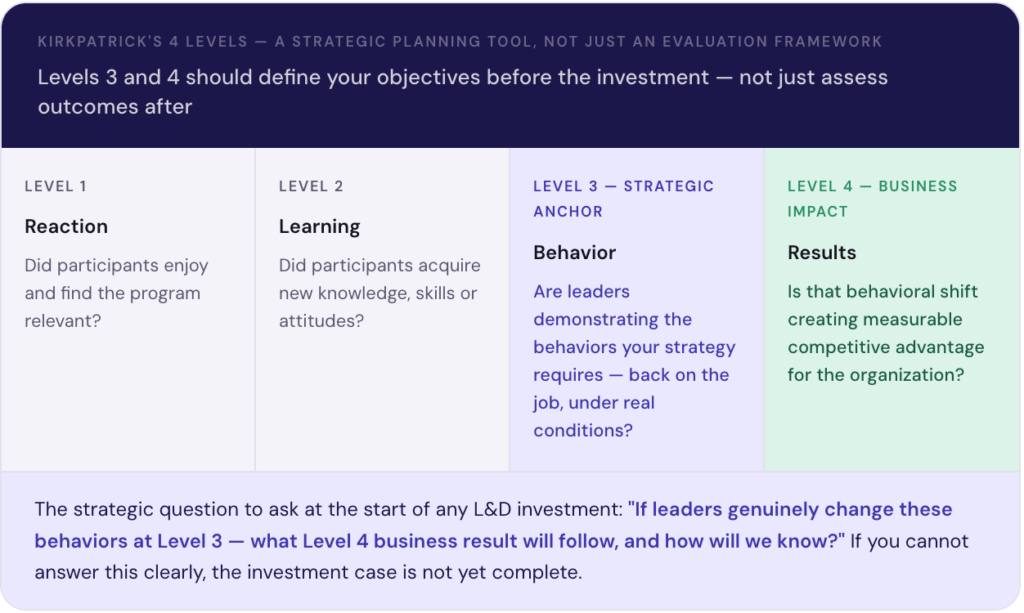
Most organizations treat the Kirkpatrick model as something you apply after a program ends, to assess whether it was worth running. Used strategically, however, Levels 3 and 4 belong at the beginning of every L&D decision — before a single program is designed or a single budget line is approved.

When Level 3 behaviors are defined upfront — anchored in what the business strategy actually needs — the entire L&D function gains a clarity that program-first thinking never produces. Development stops being measured in inputs (courses delivered, hours completed) and starts being measured in outputs: leaders who behave differently, and businesses that perform better as a result.

The question every framework eventually arrives at

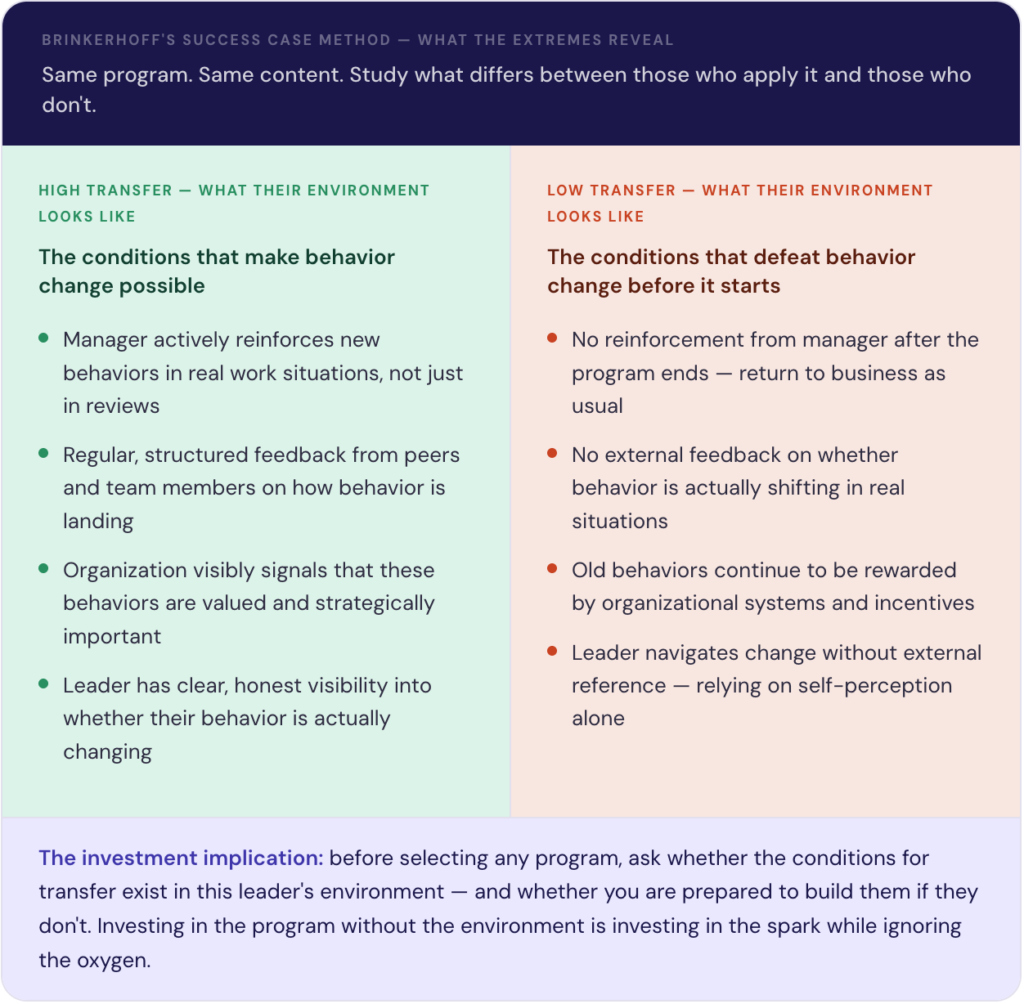
Across the 70-20-10 model, Phillips ROI, and Kirkpatrick Levels 3 and 4, a shared gap eventually surfaces: if desired behaviors are the anchor for L&D investment, and behavioral change is the proof of return on that investment — who is watching whether those behaviors actually changed?

The 20% in the 70-20-10 model — learning from others — points toward the answer. But it requires a mechanism: something that gathers structured, honest input from the peers, team members, and managers who actually experience a leader’s behavior every day. Not a self-report. Not an end-of-program survey. An external view, gathered from the people closest to the work.

In the next article in this series, we explore how organizations can use that mechanism to make more intentional decisions about who to develop, what to focus on, and how to design development programs that are built around the behaviors that matter most — before the first session is ever run.

Beaconex · 360 Feedback Solutions

Curious how other organizations are connecting L&D investment to business outcomes?

We’d be glad to share what we’re seeing — no pitch, just a conversation.

Start a conversation

Rethinking Employee Engagement Surveys: A Better Way to Measure & Improve Employee Experience

Employee engagement surveys have long been a staple in HR strategies, but let’s be honest—many of them fall short. Traditional surveys often focus on vague emotional sentiments (“Do you feel valued?”) rather than concrete experiences, are conducted too infrequently to drive real change, and feel like just another corporate checkbox exercise.

What if we could transform engagement surveys into something more meaningful, frequent, and—dare we say—even fun? Here’s how we can rethink employee surveys to make them more experience-driven, actionable, and engaging.

  1. Measure Employee Experience, Not Just FeelingsInstead of asking generic questions like “Are you happy at work?”, we should focus on specific moments that shape the employee experience:• “How easy was it to get the tools you needed to complete your last project?”“Did your last 1:1 with your manager provide clear direction?”“How would you rate the onboarding process for your new team member?”By tying questions to real workplace interactions, we get actionable insights—not just abstract satisfaction scores.
  2. Pulse Surveys > Annual SurveysWaiting for an annual survey is like checking your heart rate once a year—it’s too late to fix anything when the data finally comes in. Instead, short, frequent pulse surveys (quarterly or even monthly) allow us to:• Catch issues before they escalate• Track improvements in real time• Keep a finger on the pulse of employee sentiment
  3. Make It Fun (Yes, Really!)Surveys don’t have to be boring. Gamification, emoji-based reactions, and quick polls (e.g., “How was your week? 🔥 😊 😐 😩”) can boost participation and make feedback feel less like a chore.
  4. Close the Loop with Action

The biggest flaw in traditional surveys? Employees never see the impact of their feedback. To fix this:

Share results transparently (good or bad)

Commit to 1-2 key changes based on feedback

Follow up to show progress.  When employees see their input driving real change, they’ll be more engaged in the process.

The Future of Employee Feedback

By shifting from generic engagement surveys to frequent, experience-driven pulse checks, we can create a culture of continuous listening and improvement. The goal? A workplace where feedback is meaningful, fun, and—most importantly—acted upon.

What’s your take? How would you redesign employee surveys in your organization?

Email : Talk2Us@beacon-exp.com

LineID : Beaconex

HR’s Secret Weapon: 360 Feedback Turns Office Gossip Into Growth

Because ‘he said/she said’ is for soap operas, not your talent strategy. Modern HR should spend more time on facilitating quality people decisions. Do not get busy with ‘here says’ messages or individual complaints. 360 feedback turns:

🔮 Subjective whispers → Objective insights

🗑️ Complaints → Actionable coaching plans

😤 ‘Karen from Accounting’ (very generic) → ‘Karen scores 4/10 on collaboration’ (Precise and Now that’s HR’s business!)

3 Ways 360o Feedback Upgrades HR :

  1. Save HR from Feedback Trap“When ‘feedback’ is just whispers in the breakroom, you’re not managing talent—you’re playing telephone.”     Having regular feedback system helps elevate ‘open’ organization culture and helps channel feedback data more accurately.    To ensure accurate and quality feedback flows within the organization, training and communications on providing and receiving feedback are also critical to success.
  2. Change From ‘Opinions’ to ‘Objectivity’For example: A high-potential employee’s peers rate their collaboration 3/10— now you have a development need, not a ‘personality clash.’
  3. Change From ‘Complaints’ to ‘Coaching Plans’360o Feedback Data shows blind spots in many ways, including strengths and weakness.   Stats from our past project experience, 90%+ of talents embrace feedback more objectively and it is easier to turn those feedback into development plans
    • Feedback Data/Patterns → “Low scores on ‘active listening’ from 4 raters”
    • Development Plan to Fix → 3-month coaching focus on reflective questioning

Drop us a message if you’ve ever wished for less drama and more data in talent decisions.

Email : Talk2Us@beacon-exp.com

LineID : Beaconex

Why 360-Degree Feedback Fails (And How to Make It Work)

“Many organizations invest in 360 assessments, only to see little change. Why?”

Top Reason#1 : The Promise vs. Reality of 360o Feedback

Our research on Follow-Through showed significant drop (55%+) on action plan after the feedback. Thus the Reality is far below the Promise on leadership development plan,  both for individual level and collectively as a group. Even worst than the above: No action plan : When Feedback is collected, then ignored

How to Make It Work :

  1. Embed Feedback process into process that is always ‘monitored’ or design process that have effective performance measures and check-in regularly.
  2. Focus on 1-2 growth areas – Avoid “fix everything” paralysis and Overwhelming that make Leaders don’t know where to start .   Select key areas that align with performance goals or strategic priorities for the year so that the leader has opportunities to improve as well as enhance their performance as a leader for the organization.

Top Reason#2 :  Fear-driven culture 

Employees don’t give honest input because they are uncertain of the consequences.   This could lead to bias and inaccurate feedback.

How to Make It Work

  1. ✅ Psychological safety first – Train teams on giving/receiving feedback.   Ensure communications before/after are done properly for both Leaders and Feedback Providers.
  2. ✅ Pair feedback with coaching – Help leaders interpret and act on insights.   Ensure the coaching is provided to empathize the data and pivot on opportunities for development, instead of emotional feeling to find out ‘who said what’ and denial mode.   

2025 Best Practices for Leadership Assessment and Development

Competency ของการเป็นผู้นำกำลังเปลี่ยนแปลงอย่างรวดเร็ว จากการพัฒนาเทคโนโลยี ความคาดหวังของบุคลากร และ generations ที่เปลี่ยนไป และความซับซ้อนของสภาพแวดล้อมทางธุรกิจระดับโลกที่เพิ่มขึ้น เมื่อเราเข้าสู่ปี 2025 องค์กรต่างๆ ต้องปรับปรุงกลยุทธ์การประเมินและพัฒนาผู้นำเพื่อสร้างผู้นำที่คล่องตัว ยืดหยุ่น และมีความสามารถในการบริหารทีมที่หลากหลาย

ในบทความนี้ เรารวบข้อมูล Best Practices สำหรับการประเมินและพัฒนาผู้นำในปี 2025 โดยอ้างอิงจากงานวิจัยและตัวอย่างจริงจากองค์กรชั้นนำทั่วโลก  ซึ่งสรุปได้ 5 หลักการดังนี้

  1. ใช้การประเมินใช้ข้อมูล  แทนเชิงอัตวิสัย  ใช้เครื่องมือขับเคลื่อนด้วย AI และใช้ data ในการช่วยออกแบบแผนพัฒนา
  2. ฝึก EQ ก่อน แล้วจึงฝึกทักษะ โดยเฉพาะในอุตสาหกรรมที่มีความเสี่ยงสูง และมีการเปลี่ยนแปลงทางธุรกิจ
  3. ผนวก DEI เข้ากับการเลื่อนตำแหน่ง ด้วยเป้าหมายที่วัดผลได้
  4. แทนที่เวิร์กช็อป การอบรมแบบดั้งเดิม ด้วยการเรียนรู้แบบ interactive micro-learning  (VR, พอดแคสต์, การจำลอง)
  5. ยกเลิกการประเมินรายปี ปรับมาใชการให้ feedback รับคำติชมแบบเรียลไทม์ หรือมีความถี่มากขึ้น และ take action ทันที

เรามาดูรายละเอียดเพิ่มเติมกัน

1. ใช้การประเมินเชิงอัตวิสัย และใช้ข้อมูล ด้วยเครื่องมือขับเคลื่อนด้วย AI และใช้ data ในการช่วยออกแบบแผนพัฒนา การประเมินแบบเดิมมักอาศัยการประเมินเชิงอัตวิสัย ในขณะที่เครื่องมือขับเคลื่อนด้วย AI สามารถวิเคราะห์ข้อมูลพฤติกรรม รูปแบบการสื่อสาร และแนวโน้มการตัดสินใจเพื่อทำนายศักยภาพความเป็นผู้นำอย่างเป็นกลาง

ข้อมูลจากการวิจัย:

  • ภายในปี 2025 60% ของโปรแกรมพัฒนาผู้นำ จะรวมการวิเคราะห์ด้วย AI (Gartner, 2023)
  • AI ช่วยลดอคติในการวางแผนสืบทอดตำแหน่งได้ ถึง 40% (McKinsey, 2024)

ตัวอย่างการใช้ในองค์กร:

  • เทคโนโลยี (Unilever): ใช้ Pymetrics (เกมที่ใช้หลักประสาทวิทยาศาสตร์) เพื่อประเมินคุณสมบัติความเป็นผู้นำในผู้เข้าร่วมงานใหม่
  • สาธารณสุข (Mayo Clinic): นำการประเมินบุคลิกภาพด้วย AI มาใช้เพื่อระบุแพทย์ที่มีศักยภาพความเป็นผู้นำสำหรับบทบาทบริหาร

2. ความฉลาดทางอารมณ์ (EQ) และความสามารถในการปรับตัว โดยเฉพาะในอุตสาหกรรมที่มีความเสี่ยงสูง และมีการเปลี่ยนแปลงทางธุรกิจ  ด้วยการทำงานแบบระยะไกล/ไฮบริด และการเปลี่ยนแปลงอย่างรวดเร็วในอุตสาหกรรม ผู้นำต้องจัดการกับความเครียด สร้างความไว้วางใจ และปรับตัวได้อย่างรวดเร็ว

ข้อมูลจากการวิจัย:

  • 90% ของผู้นำชั้นยอด มีคะแนน EQ สูง (HBR, 2024)
  • ทีมที่มีผู้นำที่ปรับตัวได้ดี มีประสิทธิภาพเหนือกว่าคู่แข่ง 15% ในสถานการณ์วิกฤต (WEF, 2023)

ตัวอย่างการใช้ในองค์กร:

  • การเงิน (JPMorgan Chase): ฝึกอบรมผู้นำใน “ห้องปฏิบัติการความยืดหยุ่น” ด้วยสถานการณ์จำลองความกดดันสูง (เช่น ภาวะตลาดตกต่ำ)
  • องค์กรไม่แสวงหาผลกำไร (Red Cross): ใช้การฝึกสอน EQ เพื่อช่วยผู้นำจัดการความเครียดระหว่างวิกฤตการณ์ด้านมนุษยธรรม
  1. ผนวก DEI เข้ากับการเลื่อนตำแหน่ง ด้วยเป้าหมายที่วัดผลได้ ทีมผู้นำที่หลากหลายช่วยขับเคลื่อนนวัตกรรมและผลประกอบการทางการเงิน

ข้อมูลจากการวิจัย:

  • ทีมผู้นำที่มีความหลากหลายทางเพศ มีแนวโน้ม 25% ที่จะมีผลงานดีกว่าคู่แข่ง (McKinsey, 2023)
  • ผู้นำที่มีความหลากหลาย ช่วยเพิ่มผลิตภาพของทีม 17% (Deloitte, 2024)

ตัวอย่างการใช้ในองค์กร:

  • ค้าปลีก (Target): ผูกโบนัสผู้บริหารกับเป้าหมายด้าน DEI
  • เทคโนโลยี (Salesforce): จัดโครงการ “การให้คำปรึกษาเพื่อความเสมอภาค” โดยจับคู่ผู้มีความสามารถจากกลุ่มที่ขาดโอกาสกับผู้บริหาร
  1. แทนที่เวิร์กช็อป การอบรมแบบดั้งเดิม ด้วยการเรียนรู้แบบ interactive micro-learning  (VR, พอดแคสต์, การจำลอง) การฝึกอบรมแบบเดิมล้าสมัยแล้ว การเรียนรู้แบบย่อยและตรงเวลาช่วยให้สอดคล้องกับกระบวนการทำงานสมัยใหม่

ข้อมูลจากการวิจัย:

  • 75% ของพนักงาน ชอบการเรียนรู้แบบจุลภาค (LinkedIn, 2024)
  • ผู้นำที่เรียนรู้อย่างต่อเนื่องช่วยขับเคลื่อนนวัตกรรม มากกว่า 3 เท่า (MIT, 2023)

ตัวอย่างการใช้ในองค์กร:

  • การผลิต (Siemens): ใช้การจำลองด้วย VR สำหรับการฝึก “ความปลอดภัยในการเป็นผู้นำ” ระยะเวลา 10 นาที
  • การศึกษา (Harvard Business School Online): นำเสนอพอดแคสต์ความเป็นผู้นำรายวัน ระยะเวลา 15 นาที
  1. ยกเลิกการประเมินรายปี ปรับมาใชการให้ 360 degree feedback รับคำติชมแบบเรียลไทม์ หรือมีความถี่มากขึ้น และ take action ทันที การประเมินรายปีช้าเกินไป การรับคำติชมอย่างต่อเนื่องช่วยเร่งการพัฒนา

ข้อมูลจากการวิจัย:

  • การรับคำติชมแบบเรียลไทม์ช่วยลดการลาออก 14.9% (Forbes, 2024)
  • การรับคำติชมบ่อยครั้งช่วยพัฒนาทักษะความเป็นผู้นำ เร็วขึ้น 27% (Journal of Applied Psychology, 2023)

ตัวอย่างการใช้ในองค์กร:

  • เทคโนโลยี (Adobe): แทนที่การประเมินรายปีด้วยเครื่องมือ “Check-In” แบบเรียลไทม์
  • สาธารณสุข (Kaiser Permanente): ใช้แบบสำรวจผ่านแอปเพื่อปรับการสอนผู้นำทุกสัปดาห์

ข้อมูลเพิ่มเติมเกี่ยวกับการใช้ Best Practices เหล่านี้ในองค์กร

ภาคเทคโนโลยี

  • มุ่งเน้นความเป็นผู้นำแบบคล่องตัว (เช่น การหมุนเวียน “Tribe Lead” ของ Spotify)
  • ใช้แบบทดสอบการเขียนโค้ดด้วย AI เพื่อประเมินการแก้ปัญหาในผู้นำ (เช่น การแข่งขัน Hackathon ภายในของ Google)

ภาคสาธารณสุข

  • ฝึกอบรมผู้นำด้านการสื่อสารในวิกฤต (เช่น การจำลองความเข้าอกเข้าใจของ Cleveland Clinic)
  • ประเมินผู้นำผ่านตัวชี้วัดผลลัพธ์ผู้ป่วย (เช่น แดชบอร์ดความเป็นผู้นำของ Mayo Clinic)

องค์กรไม่แสวงหาผลกำไร

  • วัดผลกระทบของความเป็นผู้นำผ่านการรักษาผู้บริจาค/การมีส่วนร่วมของชุมชน (เช่น วงจรคำติชม “ผู้นำ-อาสาสมัคร” ของ United Way)

Why Leadership Assessments Matter More Than Ever

As we approach 2025, the landscape of leadership is evolving faster than ever. The skills and qualities that made a great leader in the past may not be enough to navigate the complexities of tomorrow. According to recent forecasts, the leaders of 2025 will need to excel in areas like:

  • Adaptability: Succeeding amidst ongoing change and unpredictability.
  • Emotional Intelligence: Building trust and fostering collaboration in hybrid, diverse and remote environments.
  • Tech Savviness: Leveraging AI and digital tools to drive innovation and efficiency.
  • Purpose-Driven Leadership: Aligning teams around a shared vision and values in a world where employees demand meaning in their work.

But here’s the challenge: how do we identify and develop these skills in current and future leaders?

This is where a strong leadership assessment comes in. A well-designed assessment doesn’t just measure competencies—it uncovers potential, highlights blind spots, and provides actionable insights to help leaders grow. It’s not about labeling someone as “good” or “bad”; it’s about understanding their unique strengths and areas for development so they can thrive in the future of work.

As organizations prepare for 2025, investing in leadership assessments isn’t just a nice-to-have—it’s a strategic imperative. It ensures we’re not just reacting to change but proactively building the leaders who will shape the future.

What leadership qualities do you think will be most critical by 2025? Let’s discuss!

#LeadershipDevelopment #FutureOfWork #Leadership2025 #EmotionalIntelligence #LeadershipAssessment

Let’s talk

Ready to take your business to the next level? Our consultants are here to help you navigate your corporate journey.

Address

Beaconex Co., Ltd.
5/40 Biz Town Srinakarin, Soi Srinakarin 46/1 Nongbon, Praves, Bangkok 10250

Line ID

Beaconex

Call Us

082 680 7778